47 Open Tabs.
Zero System. So I Built One.
The story behind linked — a private bookmark manager built because I had a tab-hoarding problem and couldn't find the right fix.

I'm a UX designer. I spend my days thinking about how people interact with products, where flows break down, and what makes an experience feel effortless versus exhausting.
I had 47 open browser tabs and no system for closing them.
Some were weeks old. Half of them I'd forgotten why I opened. Clicking through them to remember felt like archaeology. I'd saved things in Notes, bookmarked in Chrome, sent links to myself on WhatsApp. None of it was a system. It was organised chaos at best.
I tried fixing it properly.
Pocket needed an account and started recommending things I didn't ask for. Raindrop was closer, but still cloud-dependent, and the free tier had limits that made it feel like a trial, not a tool. Browser bookmarks just moved the problem to a folder called "Useful" that I opened maybe twice. WhatsApp to myself — if I'm being honest — was my most used method. A thread of links I scrolled past every day and never actually revisited.
None of these felt like a home for links. They felt like better junk drawers.
What I actually wanted was simple.
Save a link in one tap, from anywhere. See a proper preview so I know what it is without opening it. Group things by context. Work offline, always. Own my own data — not have it living on a server I don't control.
I looked for an app that did all of this without an account, without a paywall on basic features, without asking for more than I was willing to give.
I didn't find it. So I built it.
Same workflow I used for FamilyDose — React + Vite + Capacitor + Android Studio, with Claude as my coding partner. I describe what I want in plain language. It writes the code. When something breaks — and things break regularly — I describe what went wrong and we fix it together.
What took the most time wasn't the features. It was the details.
Auto-fetched previews turned out to be the most important thing in the whole app. When you save a URL, linked pulls the page title, favicon, and cover image automatically. You see what you saved at a glance, without opening it. That sounds small. It changes how the whole library feels — less like a list of URLs, more like a visual reading shelf.
For social links — Instagram, TikTok, YouTube, LinkedIn, X, Threads — the metadata often doesn't come through cleanly. So linked shows a branded fallback card for each platform. You always know what you're looking at.
Collections are colour-coded groups with custom icons. Mine are: Design References, Articles to Read, Tools, Watch Later. Whatever makes sense for how you think. My wife organises hers by project. Both work, because the structure is yours to define.
Tags handle the edge cases. Some links belong in two places. Tags let you cross-reference without duplicating. Filter your entire library by a tag in seconds.
The recycle bin came from a real moment. My wife — who is my primary tester on everything, and has zero patience for confusing flows — accidentally deleted a collection. The content was gone. That was a Thursday evening. By Friday the recycle bin was in the build. Deleted links stay for 7 days before permanent removal.
There's something I thought about deliberately when I was designing linked.
Most bookmark apps follow the same model. A functional free tier — just enough to feel the value — and then a paywall on the features you actually use daily. Collections capped at five. Export behind a subscription. Search limited to recent saves only.
It's a rational business model. I understand it.
But I'm a UX designer. I think about who gets access to good tools and who doesn't. A researcher building a link library for their thesis shouldn't have to pay to export their own data. A student saving study references shouldn't hit a collection limit two weeks in. A designer collecting inspiration shouldn't need a subscription to search their own saved links.
linked is completely free. No paywalls. No feature tiers. No subscription.
Not as a growth strategy. As a design decision. The tool works the same way for everyone who uses it — and I think that's what a good tool should do.
One thing I want to be honest about: link previews are fetched via a self-hosted API on Vercel. At current scale, that runs free. Everything else — bookmarking, collections, tags, offline storage, export — lives entirely on your device and has no infrastructure dependency whatsoever. If the user base grows to a point where the preview service needs paid infrastructure, I'll find a way to absorb that cost before passing it to users. My intention is to keep linked free for as long as I possibly can.
The thing I'm most proud of is what linked doesn't do.
No account. No cloud sync. No analytics. No trackers. Everything lives on your device. Export your entire library as a JSON file whenever you want. Restore it on any device. That's your backup — a file you own.
There's a PIN lock if you want it. Dark and light mode. A share sheet integration so saving from Chrome or any app is one tap. The homepage is your links. Not a dashboard. Not stats. Just the thing you came for.
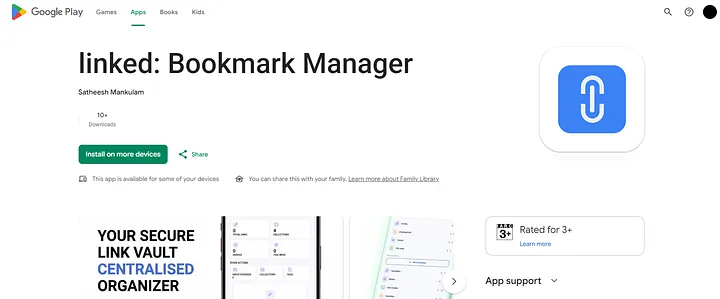
linked is live on the Play Store now. Free. No account. Your bookmarks, on your device.
If you're a designer collecting references, a researcher building a link library, a student saving study links, or just someone with too many open tabs and no real system — it might be what you've been looking for.